BRISTOL POLICE DEPARTMENT
ESTABLISHED 1893
 BPD HISTORY
updates for this page in are in progress and may
be missing elements. Check in later....
BRISTOL POLICE DEPARTMENT
ESTABLISHED 1893
updates for this page in are in progress and may
be missing elements. Check in later....
In 1877 a town meeting was held where it was decided to employ night watchmen; two men in the south village and one in the north village due to increasing burglaries. Other groups employed during this period included the Mutual Protective Association, and The Society For The Prevention of Horse Thieving, then a very serious crime. Sixteen years would pass before the town would vote to establish a formal police department. Below is a timeline tour from 1893 to present.
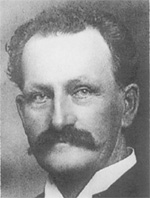 Howard G. Arms 1893-1906
Bristol's first
police chief, Howard G. Arms, served as sheriff before the department was created by the
city burgesses on November 20, 1893. At that meeting the board, the precursor to the city
council, adopted the recommendation of the special committee on police that a chief and
three policemen be hired.
The new
police chief would get a headquarters and a telephone for his official and personal use as
compensation. A year later, Arms' pay was established at $21 a week and he was issued a
uniform. The first policemen, two night officers and a Sunday patrolman, were paid 25
cents an hour. Chief Arms retired on April 1, 1906.
At the age of 26, Earnest T. Belden
joined the force as a supernumerary in 1896, rising quickly through the ranks and becoming
the departments first captain. When it needed a chief, the city looked to the
Minnesota native to lead the young force. He did so for 36 years.
Among other innovations, Belden was there when the
city purchased its first police car in 1921 and when an early pistol range was established
in 1937. Several used cars were looked at, but the city opted instead for a brand
new Hudson touring car with a $2,500 price tag its first "cruiser".
Belden attended funerals for two police officers under his command who were killed in the
line of duty by gunmen - James McNamee in 1930 and
James Burns
in 1941. Chief Belden retired in 1942 at the age of 72.
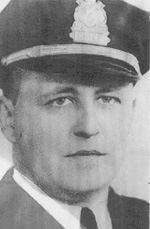 Edmund S. Crowley 1942-1956
As the police department prepared to
celebrate its 50th anniversary, the city went out of town to find a replacement for Chief
Belden. The City Hall hierarchy looked one state over to Rhode Island, hiring a
Providence sergeant to take the reins of the department.
The city's third chief was credited for the
modernization of the department during World War II and beyond. The installation of
two-way radios in cruisers paid off in a short time with the arrest of a criminal whose
description was broadcast over the air.
Chief Crowley retired in March 1956.
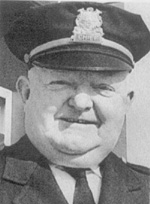 Thomas V. McCarthy 1956-1964
Born in Bristol Aug. 23, 1899, Thomas V.
McCarthy held virtually every position in the department before being named chief.
First appointed supernumerary in 1924, he became a regular patrolman two years
later; a sergeant in 1941, lieutenant in 1944, captain in 1955, and chief upon
Crowley's retirement in 1956.
In the 1940's and 50's, McCarthy worked on four sensational
murder cases while assigned to the detective division. McCarthy was 56 when he
became Police Chief. He died in 1974, 10 years after his retirement.
One month after Chief McCarthy called it
quits, the Police Department was rocked by the worst scandal in its 71 year history.
Ten officers and supervisors were suspended, and many ultimately fired or forced to
resign, after an anonymous tip from a milkman was delivered to Mayor James P. Casey about
a burglary ring involving city cops.
It was in that setting that Lt. Robert Grace assumed
the position of chief in 1964. Because of his short tenure as chief, the library's
archives pay only passing attention to Chief Grace. His successor, however, later
would recall the day in 1945 when two patrolmen; Grace, and Ptlm Meade, parlayed an
otherwise routine accident investigation into the apprehension of the so-called "Silk
Stocking Gang". Police departments throughout the state had been looking for
the bandits who flipped their car on Wolcott Street. The two officers got a week off
with pay.
Chief Grace's first wife, Erma who became the city's first
policewoman in 1960 - died in 1965. Chief Grace retired a year later.
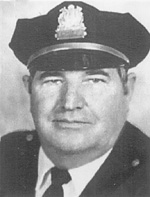 William J. Mead, Jr. 1966-1978
In July 1942, eight months after the
U.S. entered World War II, a 24 year old pipe fitter for New Departure-Hyatt followed his
father's footsteps and became a Bristol police officer. He and Ptlm Grace apprehended the
notorious "Silk Stocking Gang" in 1945 and were rewarded with a week off with
pay.
Meade was captain when the '64 burglary scandal erupted.
He said in a 1978 interview that the city "got rid of some bad apples".
Chief Meade rode out several political storms, including a 1974
ouster attempt by the mayor, and protests from the black community over the shooting death
of a shoplifting suspect by a police officer in 1971. Meade died in February, 1999.
He was remembered fondly at his funeral by working and retired officers
alike, as a chief who proudly fought to improve the department's image.
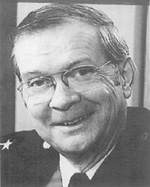 John F. Oliver 1978-1989
In August 1978, the Police Board and
City Council looked to the state's capital for its seventh police chief. John F.
Oliver joined the Hartford Police Department in 1953. by 1971 he had risen through
the ranks to become captain. When Oliver became chief of the Bristol Police
Department in 1978, he said he was attracted to the city's "small town
ambiance". But just two years later, the city became the scene of a statewide motorcycle rally protest over the light sentence of a former state
legislator got for his involvement in a car crash that killed a biker. More than 500
motorcyclists descended on the city for what Oliver would recall as a standoff, with
the crowd taunting police.
Chief Oliver who developed heart problems, left on disability
retirement in 1989.
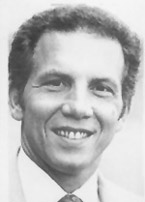 Anthony Vastola 1989-1992
Anthony Vastola was a former New York
City Police captain who served three years as Bristol's chief. Beginning with his
highly politicized selection in 1989 and ending with his abrupt resignation in Feb, 1992,
Vastola'a every move was watched closely within the Police Department.
Vastola's undoing was his submission of alleged
falsified training documents. Vastola now lives in Naples, Florida.
 William R. Kohnke 1993-1996
After a year and a half with Captain
Daniel Ahearn serving as Acting Chief, William Kohnke from Colorado, was
chosen as Police Chief and sworn in June 8, 1993.
Kohnke initiated many progressive programs in Bristol. By
obtaining technology grants, this web page was conceived and
established in 1996, one of the first in the state. The installation of Mobile Data
Terminals in the cruisers is another cutting edge tool in crime fighting. (See Technology Page ). Also established, was the ERT (Emergency
Response Team), a highly trained tactical group specially equipped to deal with barricaded
persons, hostage situations and other emergencies.
Kohnke resigned in 1996 and went on to become Chief in Pompano
Beach, Florida.
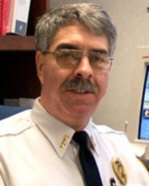 John DiVenere 1997-2011
John DiVenere was sworn in as Bristol's 10th Police Chief in April, 1997. He joined the force as a supernumerary officer in June 1976; becoming a full time officer in January 1978. Like Chief McCarthy, DiVenere worked his way up through the ranks and held nearly every position until becoming chief. His term marked the first time in over 30 years since the city had appointed an officer from the ranks to the position of Chief. DiVenere continues to add new technological advancements through federal grants and budgeting. The department has thus streamlined operations while increasing efficiency by identifying crime hotspots. As a result, overall crime has decreased through aggressive enforcement. Under his leadership, DiVenere had created specialty units, increased manpower, and put more officers on the street by hiring civilians to operate the dispatch center. His police career spanned 33 years.
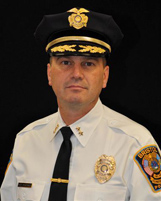 Eric
Osanitsch (2011-2012)
Eric
Osanitsch (2011-2012)In July of 2011, the Bristol city council appointed Osanitsch as the new police chief. He began to rebuild the department and modernize department procedures. The department was still reeling after unfounded allegations of racist behavior within the ranks during the previous administration. In a drawn out investigation, the DOJ, Chief States' Attny office, a private investigation firm and others determined the claims as unfounded and malicious. Cleared of any wrong-doing, the tensions in the community finally subsided and Osanitsch was credited with putting the department on a positive path forward. After leading the department for one year, he made the decision to retire after twenty-six years of service. Although he retired, his police career did not end. He became the police chief in the Town of Winsdor Locks.
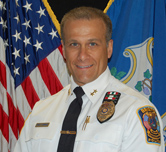
Thomas Grimaldi (2012-2015)
Grimaldi was appointed chief in 2012 by Mayor Art Ward and the city council. As chief number twelve, he continued to build the department's manpower and promoted the philosophy of community policing. During his tenure, the PD achieved Tier 1 State Accreditation, developed a career program for aspiring officers, and implemented walking beats and bike patrols in the city. Staffing was increased in the Traffic Division and a new motor unit was created. The department received over $1.8 million in grant funds for equipment and salaries. Upon retirement in 2015 he accepted a police chief position with the Port Orange Police Department in Florida.
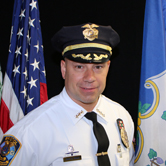
Brian Gould (2015- current)
* The city has not submitted a summary yet.
But here is what we do know..
Gould was hired as Patrolman in 1994 and was promoted through the
ranks until his promotion to chief in 2015. Recently, he presided over the
department's worst tragedy in its history when two officers;
Dustin DeMonte and Alex Hamzy,
were slain in an ambush attack. His strength, compassion and steadiness
throughout the ordeal showed him to be a true leader in the eyes of the
department, the public, and other agencies across the country. **A department
descriptive summation paragraph will be posted here when available*****

 Ptlm. Gould (6 zone) Feb, 2000
Click on the photo(s) for the full story
UNDER CONSTRUCTION
 |
May 25, 1966 Officer Shot, Kidnapper Killed. |
 |
May 18, 1996 Officer Shot, Suspect Captured. |
 |
1923 - Group Photo At H.Q.  |
 |
The 50's. Officers donate time to teach Drivers Ed' |
 |
1967 - Union is established; First Contract Signed |
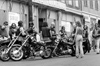 |
May 31, 1980 The M/C Riot. "Our longest day" |
 |
(not installed yet) |  |
1973 - The Team Patrol gathers by a patrol scooter |
Above is still under construction -- Check back later.
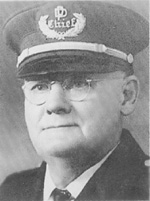
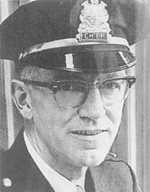 Robert J. Grace 1964-1966